Builders
What Styles Are Builders Using on Central Austin Infill Lots?
Modern, modern farmhouse, transitional, and Hill Country contemporary are the styles you'll see most on central Austin infill lots. Where each shows up, and how City rules and deed restrictions shape them.
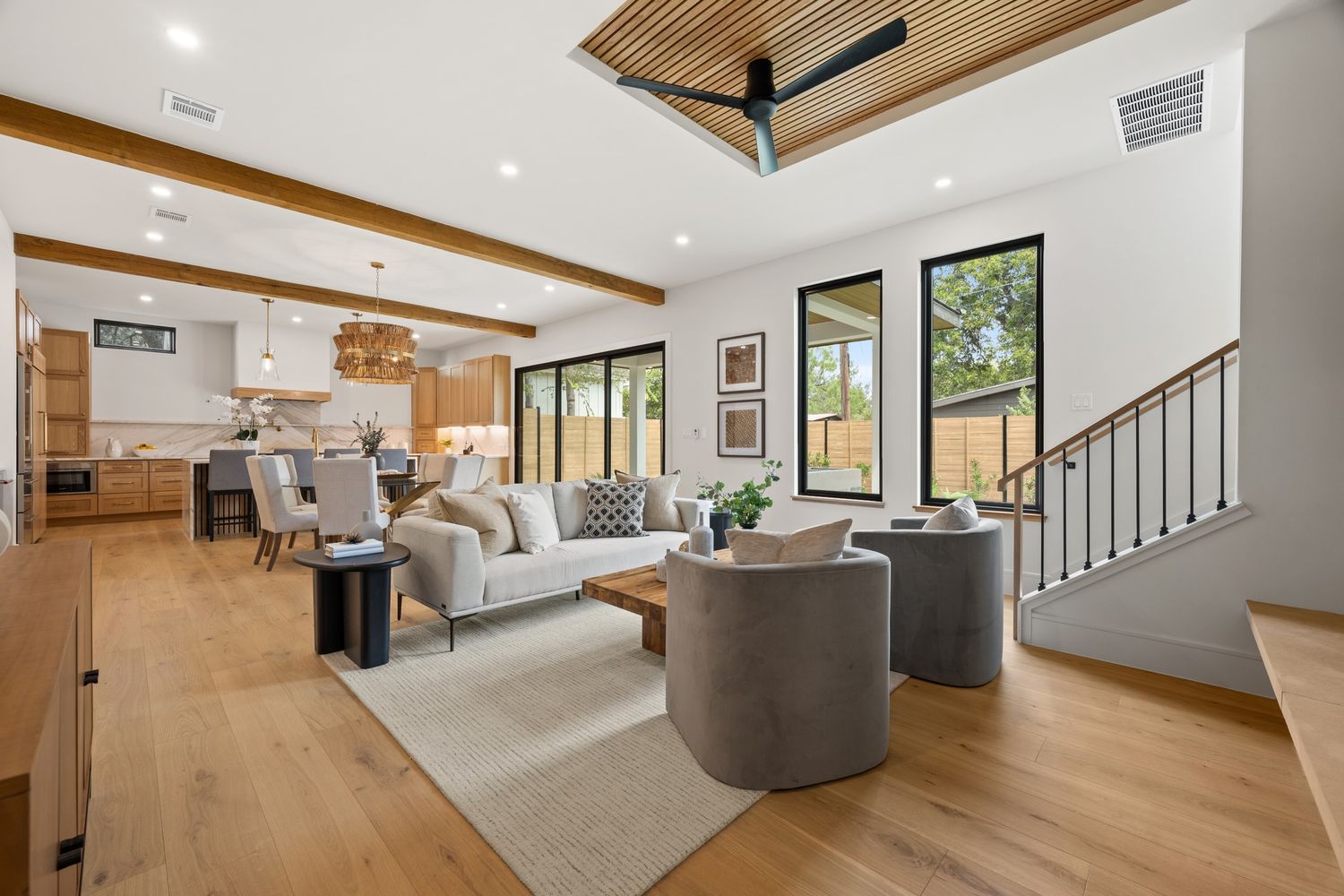
Walk a few blocks of any central Austin neighborhood with new construction and you'll see four styles over and over: modern, modern farmhouse, transitional, and what's often called Hill Country contemporary. Which one you see most depends on the neighborhood, the lot, and the builder. This post walks through each style, where it tends to show up, and the rules that shape all of them.
The four styles you'll see most
Modern
Flat or low-slope roofs, stucco or smooth siding, large black-framed windows, and a boxy massing that makes the most of a narrow lot. Modern homes are common on the east side and south of the river, where lots are often smaller and builders are fitting two or three homes on one lot. The style stacks well, which is why you see so many two- and three-story modern homes in Bouldin Creek, Govalle, and East Austin.
Modern farmhouse
A gabled roof, often standing-seam metal, with board-and-batten or lap siding, black windows, and a covered front porch. It reads as traditional from the street and modern inside. You'll see it across north-central neighborhoods like Crestview and Brentwood, where it sits comfortably next to the original 1950s ranch houses, and on larger lots anywhere a builder is building one home per lot.
Transitional
Brick or stone on the front, a hip or gable roof, and traditional proportions with cleaner trim and larger windows than an older home would have. Transitional homes are the most common choice on big lots in Allandale and Rosedale, and in west Austin, where buyers tend to want a home that looks like it belongs on the street it's on.
Hill Country contemporary
Limestone, stucco, metal roofs, deep overhangs, and lots of glass facing the back yard. It borrows from the stone ranch houses west of town and shows up on lots with trees worth looking at, especially in Barton Hills, Zilker, and west of MoPac.
Why the lot often picks the style
Builders don't choose a style in a vacuum. The lot does a lot of the choosing.
A narrow lot with two or three homes going on it pushes toward a modern or modern farmhouse design, because those styles handle a tall, slim footprint well. A wide, deep lot with one home on it opens up transitional and Hill Country designs, which want room to spread out. Mature trees matter too. Austin protects larger trees, and a protected oak in the middle of a lot can decide where the house sits and which way the big windows face.
The City rules that shape every style
Austin's HOME code changes in 2023 and 2024 allow up to three homes on most single-family lots and lowered the minimum lot size for a single home. That's why so many new builds come in pairs and threes. But HOME didn't remove the limits on size. Inside the City's McMansion boundary, which covers most of central Austin, all enclosed space counts toward the floor-to-area ratio, including garages, and the 32-foot height limit still applies. Two-unit and three-unit lots are also held to 40 percent building coverage and 45 percent impervious cover.
In practice, that's why modern infill homes tend to go up rather than out, why garages are often small or tucked under the house, and why you see so many second-floor balconies instead of ground-floor patios. The style is partly a response to the math.
Deed restrictions and historic districts
City zoning isn't the only rule on a lot. Many central Austin subdivisions were platted in the 1930s through 1960s with deed restrictions, and some of those limit height, setbacks, materials, or the number of homes on a lot. The City doesn't enforce deed restrictions, and it will issue a permit for a project that meets the Land Development Code even if a deed restriction says otherwise, so enforcement falls to neighbors or a property owners' association. The City's page on deed restrictions and development explains how to look them up in Travis County records.
A few central neighborhoods also have local historic districts, including Hyde Park and Castle Hill, where new construction has to meet design standards reviewed by the Historic Landmark Commission. New homes in those districts tend toward traditional forms because the standards call for it.
If a specific lot matters to you, ask before you fall for a design. A builder who has worked in the neighborhood will usually know the restrictions already. Our guides to Allandale, Crestview, and Bouldin Creek describe what's being built in each.
How to use this when you're shopping
If you have a style in mind, start with the neighborhoods where it's common and the builders who work there. If you have a neighborhood in mind, expect the style that fits its lots. And if you're buying before the home is finished, ask what's fixed in the design and what you can still change, since exterior materials and window packages are often decided before the slab is poured.
See the new homes for sale in central Austin, or join First Look to hear about new homes as soon as we know about them, often before they're listed.